
The priority road
On a priority road (voorrangsweg, sign B1, the yellow diamond) drivers and riders from the side roads must give way to you, at every junction, until the end of priority road sign (B2). Signs B3, B4 and B5 only apply to the next junction. Traffic lights and a traffic controller still go above them.
The signs
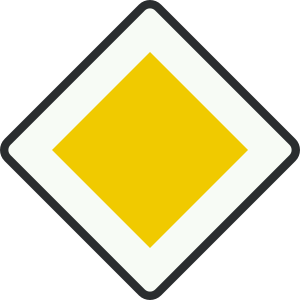 B1 · Priority roadSide roads give way to you. Lights and a traffic controller (verkeersregelaar) still overrule it.
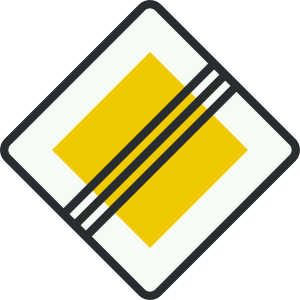 B2 · End of priority roadFrom here the normal rules return — usually priority to the right.
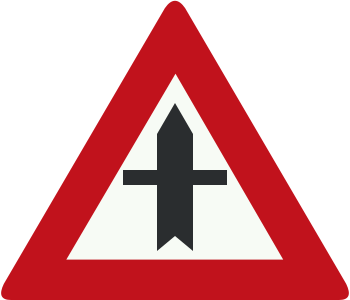 B3 · Priority crossroadsYou have priority at the next junction. Unlike B1, it applies to that one junction only.
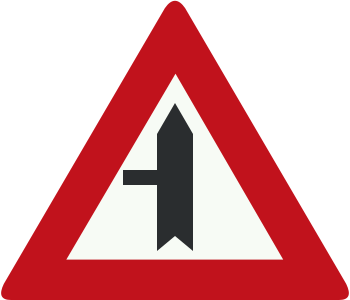 B4 · Priority crossroads, side road on the leftAt the next junction a side road joins from the left; drivers coming out of it must give way to you.
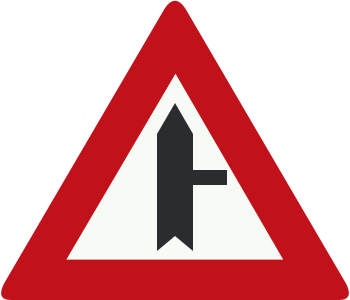 B5 · Priority crossroads, side road on the rightAt the next junction a side road joins from the right; drivers coming out of it must give way to you.
What you do in practice
- After sign B2 the normal rules apply again: often traffic from the right goes first then.
- You have priority, but someone from a side road drives on anyway? Brake: you may not cause danger, not even when you have priority.
- If you turn off the priority road, you still let oncoming traffic going straight on go first.
The mistake many people make
Thinking that B3, B4 or B5 are the same as B1. They apply to one junction only; after it the normal rules apply again.
The Dutch terms
| Dutch | English |
|---|---|
| voorrangsweg | priority road |
The rule in the law
More in this guide
Practise priority with animations and junctions like in the exam.
Start freeTheorieWin is not the CBR and does not book exams. What cbr.nl says always applies.